A Place Worth Keeping Alive
On soul, stewardship, and the people who give a place its life.
A beautiful place can impress you. A place with soul stays with you.
We often notice architecture first. The façade, the proportions of the rooms, the view from a window, the age of the stone, the shape of the garden. These are the things that appear in photographs and attract us from a distance.
But beauty is only the beginning.
Not every beautiful place receives us. Some remain images: impressive, polished and easy to admire, but somehow distant. Others possess something less easily described. They feel alive. They seem to hold their own memory, character and rhythm. They do not merely provide a setting for an experience. They become part of it. And this is what we look for in a place.
Beauty is only the beginning
A castle may have an extraordinary façade. A hotel may have beautifully restored rooms. A garden may be perfectly designed. A country house may carry centuries of history in its walls. Yet none of these things, by themselves, guarantee that the place will feel right.
A place can be visually remarkable and still feel empty. It can have everything that ought to create an atmosphere, yet lack the quality that makes people want to stay a little longer. The difference is not always visible in the architecture.
It is found in the relationship between the place and the people who care for it. In the way the rooms are maintained. In the way guests are welcomed. In the decisions that have been made over time — what has been preserved, what has been adapted and what has been deliberately left alone.
A place becomes more than its physical beauty when someone has taken responsibility for its life.
Soul cannot be installed
The soul of a place is not a decorative layer. It cannot be ordered, delivered, and arranged before the guests arrive. It is not created by adding antique furniture, vintage linen or a few carefully chosen objects. These things may support the atmosphere, but they cannot produce it on their own.
Soul is accumulated. It is found in the marks of time, in the continuity of care, in the relationship between the building and its surroundings, and in the feeling that the place has been lived in rather than merely prepared for display.
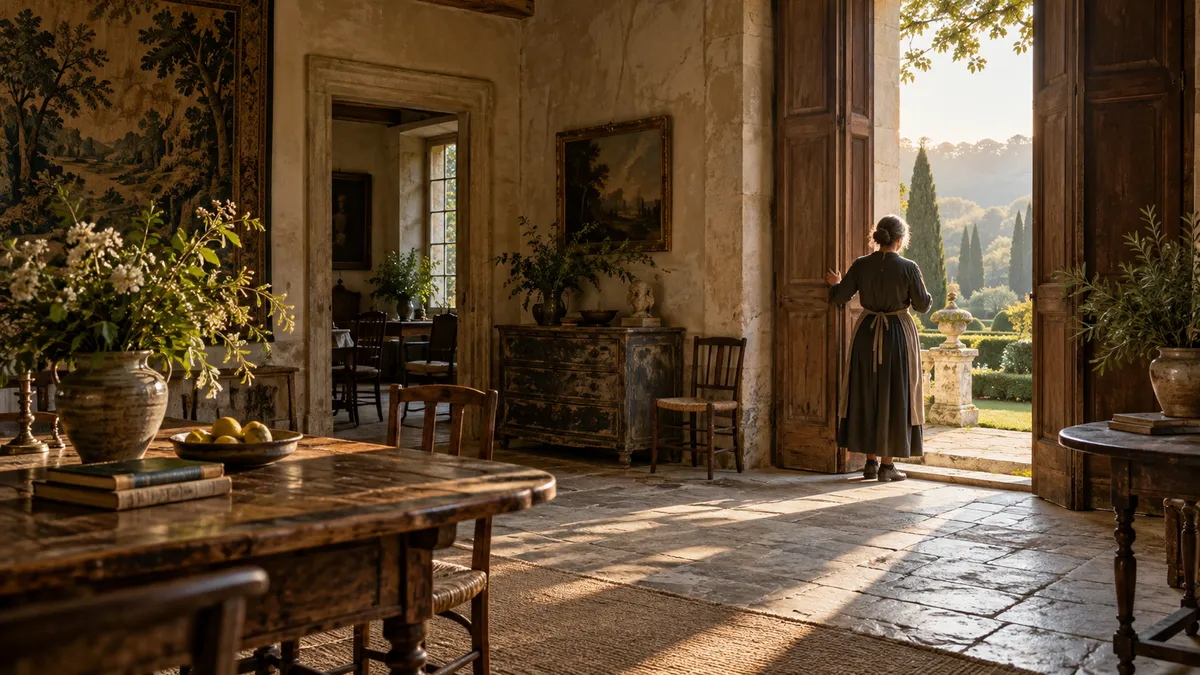
It may be present in an old staircase polished by generations of footsteps, in a garden that has grown according to its own rhythm, or in a dining room where countless conversations have taken place before ours. These details do not demand attention. They do not explain themselves. They simply give the place depth.
A house with soul does not need to pretend to be historic. It does not need to reproduce the past theatrically. Its history is already present in the way it has survived, changed, and remained in use.
People are the invisible architecture
Architecture gives a place its form. People give it its life.
Behind every place that feels genuinely alive are people who understand what they have been entrusted with. Owners, custodians, hosts, gardeners, housekeepers, chefs and members of the wider team all contribute to the character that guests eventually experience.
Their work is often invisible. That is part of its nature.
Guests may not know who opened the shutters in the morning, checked the path after rain, restored a damaged piece of furniture or decided that a particular room should remain quiet. They may never meet the person who has spent years protecting the character of the house.
But they feel the result. They feel it in the calmness of the welcome, in the confidence of the service and in the ease with which the place seems to receive them. They sense when the people behind a property care about more than appearance.
This is why two places with similar architecture can create entirely different experiences. One may be managed as an asset. The other may be cared for as a living inheritance.
The culture behind a place
Owners do not determine only the rules of a property. They determine its culture.
One owner may see a historic house primarily as an opportunity for immediate return. Another may understand that the house represents something larger than a commercial proposition. It is a piece of local memory, a home with a history and a responsibility that extends beyond the present moment.
Neither approach is invisible. It appears in the choices made every day.
Does the house retain its character, or is everything simplified for convenience? Are guests treated as interruptions, transactions, or welcome visitors? Is the team encouraged to care about the details, or only to complete the next task? Is the history of the place respected, or merely used as a marketing image?
A beautiful place can survive poor decisions for a while. Eventually, however, the difference becomes clear. The building may remain impressive, but the experience loses its warmth. What was once distinctive becomes polished, efficient, and interchangeable. The place has not disappeared. Its spirit has.
A place must be in the right hands
This does not mean that every historic place must remain untouched.
Living places need maintenance, investment and thoughtful adaptation. They need to meet the practical expectations of modern guests without surrendering what makes them distinctive. They need good lighting, reliable service, suitable facilities and a team capable of solving problems quietly.
Respecting a place does not mean asking people to endure its shortcomings. It means understanding which elements belong to its identity and which ones can be improved without erasing it. The right people know the difference.
They understand that comfort and character are not opposing ambitions. They know when to protect the old floor, when to repair it, and when to create a suitable alternative. They can introduce modern hospitality without making the house feel as though it has been stripped of its past.
This kind of care requires judgment. It also requires affection. The best places are rarely held together by one grand gesture. They are sustained by hundreds of ordinary decisions made by people who notice what matters.
When a place is truly alive
A living place does not need to be perfect.
It may have an unusual room, an uneven path, a staircase that requires attention or a garden that changes with the seasons. These things may be part of its character, provided that the people responsible for the place understand how to work with them.
Perfection is often uniform. Character is specific. A living place allows us to notice where we are. It does not behave like every other venue, hotel or event space. It has its own proportions, its own pace and its own way of receiving people.
The room may encourage conversation. The garden may ask us to walk slowly. The dining room may make dinner feel more ceremonial. The view may reward those who take the time to look for it. The place gives the experience a language. The people who care for it make that language understandable.
Place, soul and people
Over time, we have come to think of the right place as a meeting of three things:
Place gives the experience its setting.
Soul gives it depth.
People give it life.
Remove the place, and the experience loses its identity. Remove the soul, and it becomes interchangeable. Remove the people, and it becomes only architecture.
When these three elements come together, something more meaningful becomes possible. A dinner feels as though it belongs there. A journey becomes more than a sequence of stops. A wedding becomes connected to its surroundings. A gathering feels natural rather than imposed.
This is why we do not look only for beautiful places. We look for places that have something to say, and for people who understand how to let them say it.
A place becomes part of the gathering
The right place does not merely accommodate an occasion. It shapes it.
It influences how people arrive, where they pause, what they notice, and how long they remain. It gives conversation a certain rhythm. It changes the feeling of a meal. It creates memories that could not have been made in quite the same way elsewhere.
A gathering held in a historic courtyard will never feel the same as one held in a modern ballroom. A long table beneath old trees creates a different kind of intimacy from a formal dinner in a grand hall. A journey through country houses asks us to observe the landscape differently from a hurried itinerary of famous sights.
The place does not dictate the experience. But it gives the experience its character. And when the people behind the place are thoughtful, generous, and attentive, guests can feel that character without being lectured about it.
Keeping a place alive
A remarkable place should not be preserved behind glass.
It should be cared for well enough to continue its life. People should still be able to dine in its rooms, walk through its gardens, sleep beneath its roofs, celebrate important moments there and create new memories without pretending that the older ones do not exist.
This is the kind of continuity that interests us at Freire & Co.
We are drawn to places with a past, but also to what may still happen there. A wedding. A dinner. A journey. A long conversation. A gathering of people who may have arrived as strangers and left with a shared memory of the same house, the same table, and the same evening.
A beautiful place can impress you. A place with soul stays with you. And when that place is in the hands of the right people, it can offer something even more valuable than beauty.
It can remain alive. And when a place has soul, and the right people know how to care for it, something more than an occasion can begin there.
A gathering can take shape.