More Than an Occasion
THE GATHERINGS
More Than an Occasion
On weddings, dinners, long tables, and the art of bringing people together.
A gathering is not defined by how many people attend. It is defined by what they are allowed to share.
People may occupy the same room without truly being together. They may sit at the same table while remaining distracted, hurried, or distant. They may attend the same event and leave with entirely different memories of what happened there.
A gathering is something more intentional. It creates the conditions for people to slow down, to notice one another and to share a moment that could not have existed in quite the same way elsewhere.
This may happen at a wedding, around a long table, during a private dinner, on a journey through historic places or in the simple pleasure of spending an unhurried afternoon with people whose company matters.
The form may change. The purpose remains remarkably constant. To bring people together with intention.
Not every meeting is a gathering
We live in a time filled with occasions. There are launches, receptions, celebrations, dinners, conferences and carefully produced experiences. Many of them are beautiful. Some are very successful. Yet not all of them become gatherings in the deeper sense of the word.
An event can be well organized and still feel impersonal. It can have excellent lighting, beautiful flowers, a detailed schedule and a perfectly executed menu, yet leave little behind once the guests have gone home.
A gathering asks for something more. It asks whether people were given a reason to be present, a place in which to feel comfortable, and enough time for something genuine to happen between them.
The purpose does not need to be grand. A wedding. An anniversary. A shared meal. A journey. A long conversation. The return of people who have not seen one another for too long. The reason may be simple. It only needs to be true.
The place gives the gathering its tone
A gathering never exists independently of its surroundings.
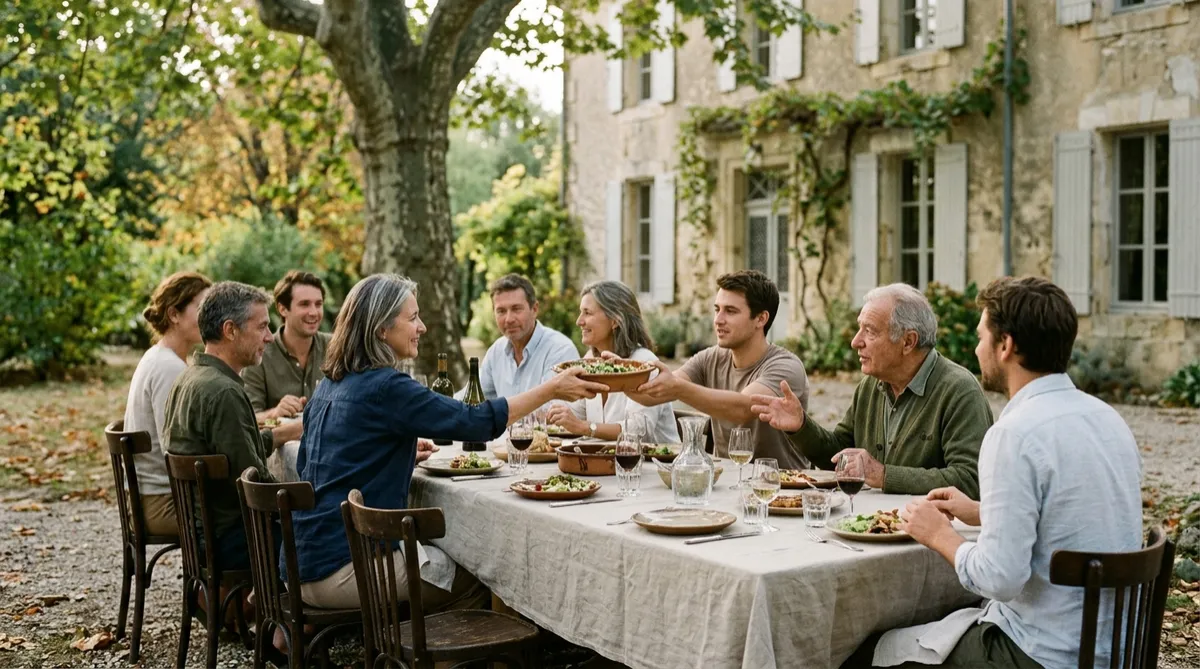
The place in which people meet influences how they arrive, how they behave, what they notice, and how long they remain. A dinner in a historic dining room does not feel the same as a dinner in a modern ballroom. A long table beneath old trees creates a different kind of intimacy from a reception in a hotel conference space.
This is why we are drawn to places with history.
A historic place brings something with it before the first guest arrives. Its architecture, proportions, materials and surroundings have already shaped countless moments. It carries a sense of continuity that cannot be manufactured for a single occasion.
A gathering held in a place with history does not begin with a blank canvas. It enters a story that has already been unfolding for generations — and, for a brief moment, becomes part of it.
The place is not merely a backdrop. It gives the gathering a tone, a sense of belonging and a depth that no temporary decoration can provide. We do not begin with an empty space and decorate it until it feels meaningful. We begin with places that already carry meaning — and create gatherings that belong there.
People are more important than the program
The best gathering is not necessarily the one with the most elaborate program. It is the one in which people feel sufficiently at ease to be themselves.
A schedule may be necessary. Timing matters. Good organization allows a gathering to move with confidence. But the program should support the experience rather than consume it.
There must be room for the conversation that lasts longer than expected. For the guest who arrives early. For the story that is told twice. For the walk through the garden after dinner. For the moment when strangers discover that they have more in common than they first imagined.
The most memorable parts of an evening are often not the ones announced in advance. They are the moments that become possible because the structure was thoughtful enough to leave space.
The best gatherings leave room for something unplanned.
This is not an argument for carelessness. It is an argument for a different kind of care — one that understands that people are not an audience moving through a production. They are participants in a shared experience.
The art of receiving people
Hospitality begins before a guest asks for anything. It is present in the welcome, in the lighting, in the pace of the service, in the way a room is prepared and in the quiet confidence of the people looking after it. Good hospitality does not draw attention to every effort made on behalf of the guest. It simply removes unnecessary friction.
The directions are clear. The room is ready. The path is easy to find. Someone notices when a guest needs assistance. The meal arrives at the right moment. A question is answered properly. A problem is resolved before it becomes the center of the evening. None of these details is particularly theatrical. Together, they create the feeling that the guest has been considered.
This is where luxury becomes more than appearance. True luxury is not only a beautiful setting, an excellent wine or a carefully chosen piece of furniture. It is the feeling of being personally cared for without being made to feel managed.
It is comfort with discretion. It is generosity without performance. It is the knowledge that someone has thought about what the experience should feel like from the other side of the table.
A wedding is more than a wedding day
A wedding may be one of the most significant forms of gathering, but it is not limited to the ceremony and the evening reception.
The gathering begins when people arrive. It may include the first welcome, a dinner the night before, a morning spent together, a ceremony, a long table, a walk through the grounds, and a quiet brunch before everyone returns home. The wedding day is only one part of the story.
What makes a celebration meaningful is often the time surrounding it — the hours in which family and friends are able to meet without being rushed from one formal moment to the next.
This is why we are drawn to multi-day celebrations. They allow people to inhabit a place rather than simply visit it. They create the possibility of familiarity. Guests learn the house, recognize the paths, return to the same table, and begin to feel that they belong to the setting.
A wedding held in this way becomes less like a single performance and more like a shared chapter in the lives of everyone present.
The long table
There is a reason the long table has remained such a powerful symbol of hospitality. It is not only a piece of furniture. It is an invitation to participate.
A long table changes the way people sit. It creates connection across the meal. It places guests near people they may not already know. It encourages conversation, shared plates, passing dishes and the small exchanges that make a dinner feel alive.
At a long table, no one remains entirely anonymous. The table creates a social landscape of its own. It gives a dinner rhythm and shape. It allows silence, conversation, laughter, and attention to coexist.
This is part of what interests us about The Long Table Society. The table is not the destination. It is the setting in which something between people may begin.
The meal matters, of course. So do the flowers, the linen, the candles and the room. But their purpose is not to impress in isolation. Their purpose is to make the gathering feel natural, generous and worthy of the time people have chosen to spend together.
Different forms of shared time
Not every gathering needs to be large. Some of the most meaningful ones are intimate by nature.
A private dinner. A bridal gathering. An afternoon of conversation. A journey through historic houses. A weekend in the countryside. A small celebration around a table. A group of people brought together because they share a particular curiosity, taste or way of seeing the world.
Brides & Bubbles may take one form.
The Long Table Society may take another.
A wedding, a private journey or a dinner may appear entirely different again.
Yet they belong to the same wider idea: creating a setting in which people can spend time together with greater attention and less haste. The format is secondary. The quality of the time is what matters.
A quiet answer to a hurried world
Modern life divides our attention constantly. We move between screens, messages, obligations and destinations. We are often present physically while our minds remain elsewhere.
A well-made gathering offers a quiet alternative. It gives people time without demanding that they fill every moment. It allows a meal to remain a meal, rather than becoming something consumed between other obligations. It gives conversation the dignity of being uninterrupted.
This is one of the reasons gatherings belong naturally within the idea of Slow Luxury. Slow Luxury is not simply a visual style. It is a different relationship with time.
It values presence over speed, quality over excess, and depth over constant novelty. It understands that some experiences become more meaningful when they are allowed to unfold gradually.
A gathering cannot be hurried into existence. People need time to arrive, to settle, to open themselves to one another and to become part of the atmosphere of the place.
What remains after the guests leave
The final course is served. The candles burn lower. The last conversation comes to an end. Cars depart, and the house becomes quiet again. But the gathering does not disappear entirely. Something remains.
A shared memory. A new friendship. A story that will be told again. A photograph that carries more meaning because everyone remembers what happened immediately before it was taken.
Perhaps the most valuable result is the feeling that, for a brief period, people were part of something larger than their individual routines. They shared a place, a table, a journey or an important moment. They were not simply attending an occasion. They were living inside a story together.
Making gatherings possible
At Freire & Co., we are interested in what happens when place, people, time and intention come together. We do not create gatherings only to fill a calendar. We look for the right setting, the right rhythm and the right people. We think about how guests will arrive, what they will experience and what they may remember afterward.
Sometimes that means a wedding in a historic house. Sometimes it means a dinner beneath old trees, a journey between castles, a table prepared for people who have never met before or a small celebration that matters deeply to those involved.
The form may change. The principle does not. A gathering is not something we simply organize. It is something we make possible — a moment in which place, people and time come together, and ordinary hours become part of a shared story.
That is why the most important question is not always:
What are we planning?
Sometimes it is:
What do we want people to feel when they are together?
