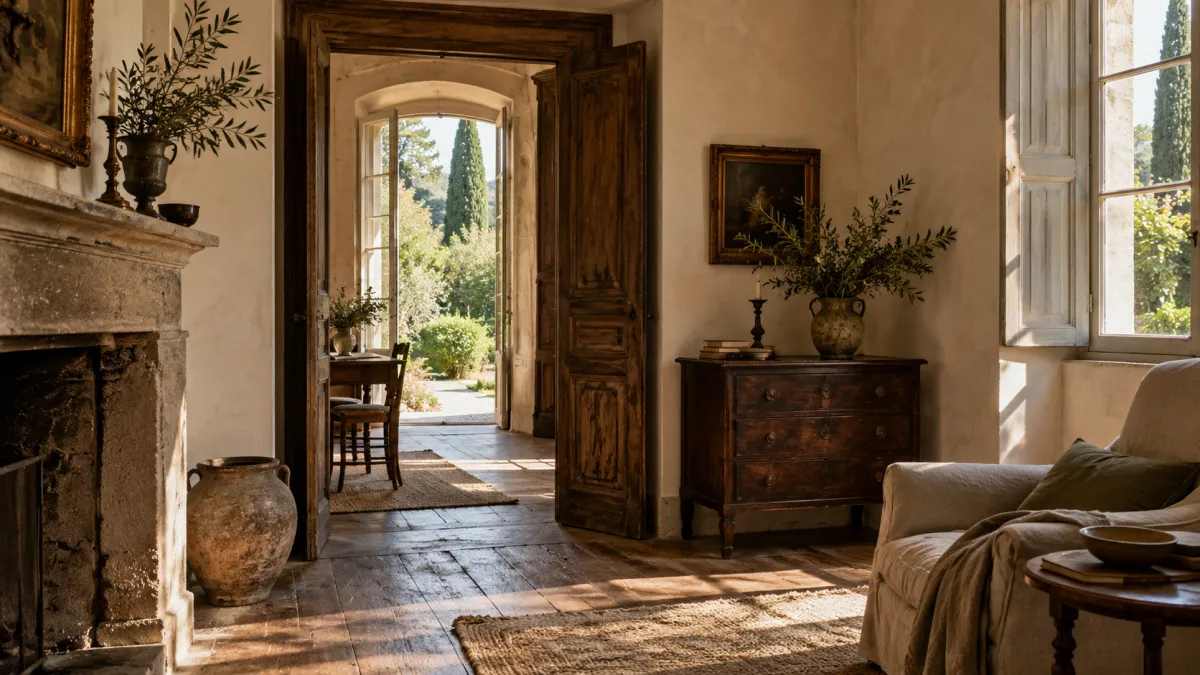
The House
On atmosphere, memory and the character of places.
A house is more than walls, windows and a roof.
It is more than the rooms contained within it, more than the furniture placed in them, and more than the view beyond the glass. A house becomes a house through the way it is lived in, cared for and remembered.
This is true of private homes, of course. But it is also true of old hotels, country estates, castles, villas and houses that welcome people for only a few hours or a few days. Some places receive us. Others seem to recognise us.
The difference is rarely a matter of size or cost. It is a matter of character.
A place is not a stage
There is a temptation, whenever a place is prepared for an occasion, to treat it as a blank stage. A room is emptied. A style is selected. Flowers, furniture, candles and linen are brought in. The space is transformed according to a plan.
Sometimes this is necessary. Every gathering requires a certain degree of preparation. But the most successful places do not lose themselves in the process.
They remain recognisable.
The old staircase is still allowed to be old. The garden retains its natural rhythm. The proportions of the room are respected. The light is not forced into submission. The table, the flowers and the music are chosen to belong to the place, rather than to compete with it.
Good design does not erase character. It makes character easier to see.
This is one of the first questions we ask of any place: what is already here, and what should be left untouched?
Atmosphere cannot be installed
Atmosphere is often discussed as though it were an object, something that can be ordered, delivered and installed before the guests arrive.
It is not.
Atmosphere begins with the relationship between things. The quality of the light at a particular hour. The distance between the house and the garden. The sound of footsteps on an old floor. The way a door opens into a room. The silence before dinner begins. The decision to place a table near a window, or not to place one there at all.
These details may be small, but they alter the way a place is felt.
They also require time. A room cannot be understood from a floor plan alone. A house must be visited in the morning and in the evening. In sunlight and in rain. When it is empty, and when it is full of people.
The atmosphere of a place is not a decorative layer added at the end. It is the result of paying attention from the beginning.
Memory gives a place its depth
The finest historic places carry their past without constantly explaining it.
Their depth is found in the worn threshold, the faded paint, the old trees, the uneven stone, the portraits that have watched generations pass, and the rooms that have hosted more conversations than anyone could count.
These traces are not imperfections to be corrected. They are evidence that the place has been used, valued and kept alive.
Of course, historic buildings need care. They need restoration, maintenance and sometimes considerable investment. Preservation is not the same as allowing a house to decline. It is the patient work of protecting what gives the house its identity while allowing it to remain useful in the present.
A house that cannot be lived in becomes a museum. A house that forgets its past becomes a hotel set.
The balance between the two is delicate. It asks for respect rather than imitation.
Character is not perfection
Modern hospitality often rewards uniformity. Clean lines. Predictable service. Rooms that look the same wherever one goes. Everything polished, efficient and immediately legible.
There is comfort in this. But there is also a risk: when every detail is perfected in the same way, nothing remains distinctive.
Character requires a certain amount of resistance. A house may have a narrow staircase, an unusually shaped room, a garden that cannot be seen from every table or a view that depends on where one happens to stand. These things are not problems to be solved automatically. Sometimes they are precisely what make the place memorable.
The purpose of good planning is not to make every place behave like every other place. It is to understand the character of a particular place and create within its possibilities.
Each begins with a simple question:
What does this place make possible?
The answer will be different in a castle courtyard, an Italian garden, a country house dining room or a quiet estate at the edge of a forest.
Care is the quiet form of luxury
The word luxury is often attached to what is rare, expensive or visibly impressive. But in practice, the most convincing luxury is frequently quieter.
It is the room prepared before anyone asks. The path that is lit correctly. The welcome that feels warm without becoming theatrical. The meal served at the right pace. The host who notices when a guest needs something and acts before the need becomes a request.
Care is rarely dramatic. It is made up of hundreds of decisions that most guests will never see.
That does not make it less important. It is often the reason an experience feels effortless.
This is why we are drawn to places that have been looked after over time. Their beauty is not merely visual. It is the visible result of attention: someone repaired the roof, opened the shutters, planted the garden, polished the silver, preserved the room and thought about the people who would arrive next.
In this sense, hospitality begins long before the first guest enters.
A house gives shape to a gathering
The nature of a gathering is influenced by the place that receives it.
A long table beneath old trees creates a different kind of conversation from a formal dinner in a great hall. A ceremony beside a fountain has another rhythm from one held in a chapel. A journey through historic estates asks us to notice different things from a fast itinerary of famous sights.
The place does not dictate the experience, but it gives it a language.
This is why we do not believe that every event should be designed from a blank page. The better starting point is to listen to the place first.
Where should people arrive? What should they see first? Where might they naturally linger? Which room wants conversation, and which one wants music? When should the gathering move, and when should it remain still?
These are practical questions, but they are also cultural ones. They determine whether a gathering feels imposed upon a place or genuinely belongs there.
Keeping a house alive
To care for a remarkable place is not to preserve it behind glass.
It is to allow it to continue its life.
Old houses remain meaningful when they are used with respect. When people dine in them, celebrate in them, sleep in them, walk through their gardens and create new memories without pretending that the older ones do not exist.
This is the kind of continuity that interests us at Freire & Co. We are drawn to houses that have a past, but also to what may still happen there. A wedding. A dinner. A journey. A conversation that lasts longer than expected. A new chapter in the life of the house, and perhaps in the lives of the people who have entered it.
The house is never only the setting.
It is part of the story.
And before there can be a table, there must be a house capable of receiving it.
That is where the next room of this Journal begins.
