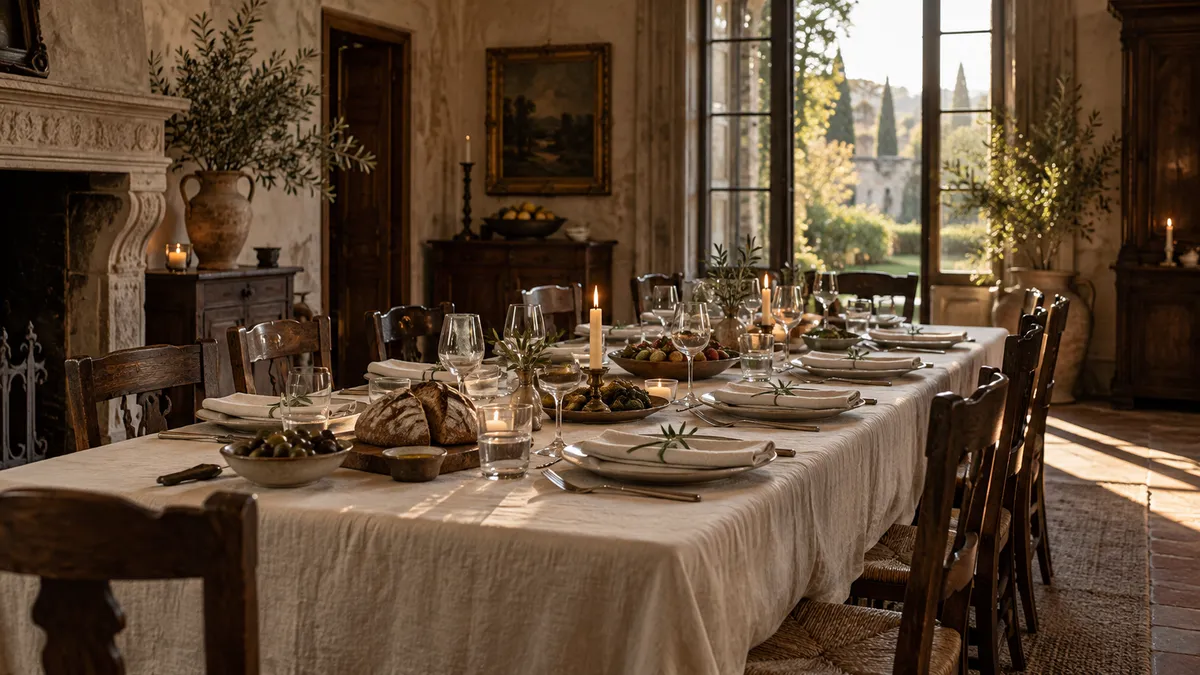
The Table
Why Food Is Never Just Food
On hospitality, memory and the quiet theatre of a well-prepared gathering.
Food is often the first language of a house.
Long before guests understand the history of a place, notice the portraits on its walls or learn the names of those who once lived there, they are offered something to drink. A tray appears. Bread is placed on the table. The kitchen sends its first quiet signal that the house is ready to receive them.
This is where hospitality begins.
At a gathering, food is sometimes treated as a practical part of the program: something to be selected, scheduled and served between the speeches, the music and the conversation. Yet the table carries far more meaning than this. It is one of the clearest ways in which a host tells their guests:
We thought of you. We wanted you here. This was prepared for you.
The most memorable meals are rarely remembered for being the most elaborate. They remain with us because they belonged to their setting.
Perhaps the ingredients came from the surrounding countryside. Perhaps the recipe had been served in the family for generations. Perhaps dinner was held beneath old trees, in a castle dining room or at one long table overlooking a vineyard. The food, the place and the occasion spoke the same language.
A menu should reveal where we are.
This does not require theatrical references to local cuisine, nor a procession of dishes designed chiefly to impress. It may be something as simple as seasonal produce, bread from a nearby bakery, wine from the region or a dish prepared with confidence because the kitchen knows it well.
There is a particular elegance in food that does not try to be from everywhere.
A well-considered menu also helps shape the rhythm of an evening. A welcome drink allows people to arrive gradually. Small dishes encourage movement and conversation. A shared meal gathers everyone around the same table. Dessert loosens the formality of the dinner and allows the evening to change direction.
Food does not merely accompany a gathering. It helps determine how the gathering feels. This is especially apparent when the service is given the same thought as the food itself. There are moments when a meal goes further than expressing a place. In the right hands, it can become part of the evening's theatre.
We saw this at a wedding, where Beef Wellington was not simply plated and quietly carried from the kitchen. The service had been rehearsed in advance. The waiters appeared in dark suits and white gloves, moving with deliberate timing. The maître d'hôtel directed the sequence from the center of the dance floor while a string orchestra played.
For several minutes, dinner ceased to be a practical necessity and became part of the performance.
Not because it was loud or extravagant, but because every element had been given its place: the dish, the movement, the music, the room and the anticipation of the guests. The arrival of the meal became a small ceremony in itself.
This is not spectacle for its own sake. It is hospitality shaped with such care that the act of serving becomes memorable.
There is an important distinction here. Hospitality is not performance, even though it may sometimes contain theatre. The purpose is not to make the guests admire the people serving them. The purpose is to make them feel that the moment has been prepared with care.
The performance belongs to the occasion, not to the ego of the people delivering it.
The same principle applies to quieter forms of hospitality. True care is often found beyond the menu. It is in the timing of the service, the temperature of the meal, and the ease with which a dietary need is accommodated without making a guest feel troublesome. It is a glass quietly refilled, a child served before becoming restless, and a late-arriving guest welcomed without commotion.
These details seldom appear in photographs. Yet they shape how the gathering is remembered. Flowers may define the appearance of a table. Food and service determine how it feels to sit there. A table can be long or small, formal or relaxed, laid beneath chandeliers or beneath the open sky. Its character is not determined by its size or its cost. It is created by the attention behind it.
Someone has considered where the guests will sit. Someone has thought about how the food will arrive, where the conversation might begin, and when the evening should change its pace. Someone has noticed that the room, the music, the meal and the people should not compete with one another, but belong together.
This is the invisible architecture of a gathering.
The table also gathers more than people. It brings together families, generations, languages and memories. It gives strangers a reason to speak and old friends a reason to remain a little longer. At a wedding, two families may meet for the first time around it. At a private dinner, a conversation may continue long after the plates have been cleared. At a long table beneath the trees, people who arrived as individuals may leave having shared something that could not have happened elsewhere.
The meal becomes part of the story of the place.
This is why dinner should never be treated as an interval between the more visible parts of an occasion. It is not a pause between the ceremony and the dancing, nor simply another item on a program. It is one of the central acts of gathering.
To feed people is to receive them. To feed them thoughtfully is to tell them that their presence matters.
The best food does not announce what the host could afford. It does not insist on its own sophistication. It says something quieter:
Welcome. This place, this time and this table were prepared with you in mind.
And sometimes, when the setting, the service and the people are perfectly attuned to one another, the meal becomes more than something we remember tasting.
It becomes something we remember being part of.
